Delivered by:
Dr. Ibrahim M. Zikirullahi
Executive Director, Resource Centre for Human Rights & Civic Education (CHRICED)[1]
Palais des Nations, Geneva, Switzerland – July 13, 2026
The Chairperson, Distinguished Experts, Esteemed Delegates,
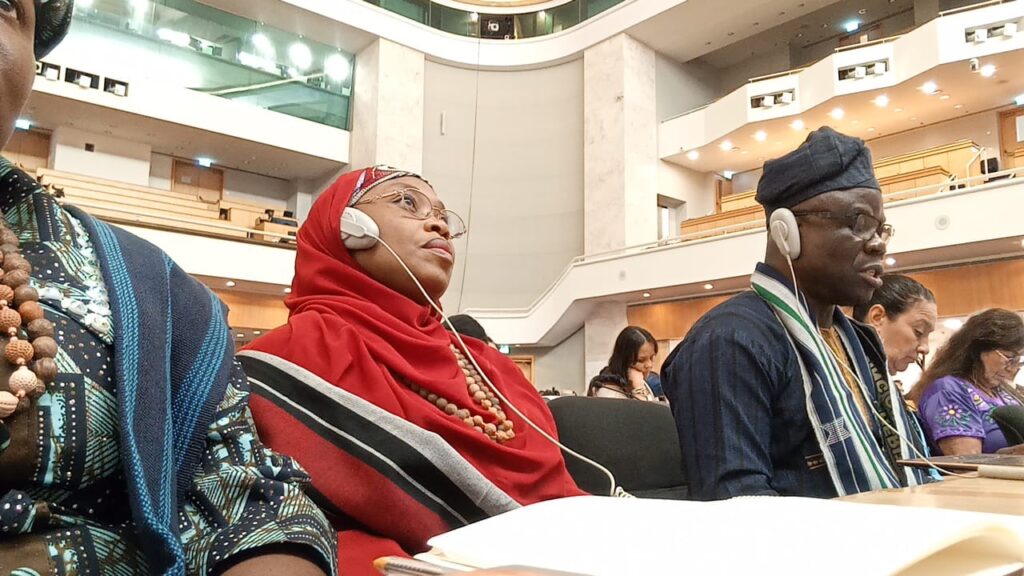
My name is Dr. Ibrahim M. Zikirullahi, Executive Director of the Resource Centre for Human Rights & Civic Education (CHRICED). I am accompanied by three Indigenous delegates, with the support of the John D. and Catherine T. MacArthur Foundation, to once again draw urgent global attention to the worsening human rights situation of the Indigenous Peoples of Nigeria’s Federal Capital Territory (FCT), Abuja—known as the Original Inhabitants (OIs).
At the 18th Session last year, we reported that “over two million Indigenous people of the FCT face systematic exclusion, land dispossession, political disenfranchisement, and cultural erasure.” Today, it is with deep concern that I must inform this Mechanism that their plight has deteriorated significantly over the past year.
- Abuja’s Indigenous Peoples in Conflict and Post‑Conflict Conditions
Although Abuja is widely perceived as a peaceful administrative capital, the lived experiences of its Indigenous Peoples reveal a persistent structural conflict—rooted in forced displacement, land appropriation, and political exclusion.
- Escalating Demolitions as Structural Violence
In the past year, multiple Indigenous communities have suffered state‑led demolitions of homes, farms, and cultural sites. These actions have:
- Rendered families homeless
- Destroyed ancestral compounds
- Disrupted traditional livelihoods
- Intensified fear, instability, and psychological trauma
These demolitions constitute conflict conditions, even in the absence of armed confrontation. They mirror global patterns in which Indigenous Peoples experience violence through administrative, legal, and urban‑development mechanisms rather than overt military force.
- A Post‑Conflict Reality Without Justice
For Abuja’s OIs, a genuine post‑conflict phase has never materialized because:
- There is no restitution for lands seized under Military Decree No. 6 of 1976
- There is no compensation or resettlement, despite Supreme Court judgments affirming their rights
- There is no political representation, as OIs still cannot elect a governor or state legislature
As we stated last year, “successive governments have failed to provide compensation, resettlement, or legal recognition.” This unresolved injustice perpetuates a permanent post‑conflict crisis.
- Artificial Intelligence and Indigenous Rights:
The rapid expansion of Artificial Intelligence (AI) presents both significant risks and transformative opportunities for Indigenous Peoples.
- Risks: Data Extraction Without Consent
AI systems depend heavily on data. For Abuja’s OIs—already rendered invisible in national statistics—AI could deepen exclusion if:
- Government or private actors extract community data without free, prior, and informed consent
- AI tools reinforce biased narratives that erase Indigenous identity
- Automated systems allocate resources without Indigenous participation
Last year, we emphasized that “data is not just a technical tool—it is a vehicle for justice, visibility, and empowerment.” This truth is even more urgent in the age of AI.
- Opportunities: Advancing Indigenous Data Sovereignty
AI can support Indigenous Peoples when grounded in Indigenous Data Sovereignty, ensuring:
- Community ownership and control of data
- Ethical AI systems that respect cultural protocols
- Indigenous‑led digital archives of language, history, and ecological knowledge
- AI tools that strengthen advocacy, mapping, and documentation of violations
We urge EMRIP to promote global frameworks ensuring that AI development does not reproduce colonial patterns of dispossession.
- International Decade of Indigenous Languages
Abuja’s Indigenous languages—Gbagyi, Bassa, Gwandara, Koro, Ganagana, and others—are at severe risk of extinction due to:
- Displacement
- Urban assimilation
- Loss of cultural spaces
- Insufficient government support
The demolitions of the past year have destroyed not only homes but also linguistic ecosystems—the spaces where language is lived, transmitted, and embodied.
To align with the International Decade of Indigenous Languages, Nigeria must:
- Recognize Abuja’s Indigenous languages as national heritage
- Support community‑led language revitalization initiatives
- Integrate Indigenous languages into local education systems
- Fund digital and AI‑based language preservation tools
- Protect cultural sites essential for linguistic continuity
Language survival is inseparable from land rights, cultural dignity, and political inclusion.
- Renewed Calls to Action
Given the worsening conditions facing Abuja’s Indigenous Peoples, CHRICED urges EMRIP, member states, and relevant stakeholders to intensify pressure on the Nigerian government to implement the following:
- Immediate Protection from Forced Evictions Halt demolitions and displacement; provide restitution and rights‑based resettlement.
- Legal Recognition Formally recognize Abuja’s Original Inhabitants as Indigenous Peoples with full legal status and protections.
- Conflict‑Sensitive Development Policies Ensure development planning does not create or exacerbate conflict conditions for Indigenous communities.
- Political Inclusion Guarantee democratic participation, including the right to elect local and state representatives.
- Cultural and Linguistic Preservation Support Indigenous‑led initiatives aligned with the International Decade of Indigenous Languages.
- Ethical AI and Data Sovereignty Affirm Indigenous control over data; ensure AI systems respect Indigenous rights and cultural protocols.
- Disaggregated National Data Systems Collect and publish data reflecting the socio‑economic realities of OIs, disaggregated by tribe, gender, age, and location.
Conclusion
The Chairperson, Distinguished Experts,
Abuja’s Original Inhabitants are living through a silent conflict—marked by demolitions, displacement, erasure, and denial of rights. Their situation is not improving; it is worsening.
Development must never be weaponized against Indigenous Peoples. AI must never become a new frontier of dispossession. Language must never be allowed to die because a people were pushed off their land.
We therefore call on this Mechanism to act with urgency and resolve. Justice delayed is dignity denied.
Thank you.
[1] The Resource Centre for Human Rights and Civic Education (CHRICED) is a Nigerian nonprofit and knowledge-driven platform for active citizens for the promotion of human rights, the rule of law, democracy, and accountability. It is registered under the law of the Federal Republic of Nigeria. CHRICED’s mission is the promotion of human rights and the advancement of a democratic, representative, and inclusive political culture in Nigeria in accordance with the Universal Declaration of Human Rights, the African Charter on Human and People’s Rights, the Nigerian Constitution, and other international human rights instruments. It accomplishes this through research and publications, education, advocacy, information sharing, grassroots organizing, and networking with other human rights bodies within and outside Nigeria. CHRICED has a special consultative status at the United Nations ECOSOC and certification by NGOsource as equivalent to a U.S. public charity. The core tenet of CHRICED’s philosophy is that civic education dissemination is cardinal to the empowerment of citizens. For the past 20 years, CHRICED has built the requisite experience and track record in project management, especially in promoting human rights, deepening accountability, mobilizing marginalized groups to amplify their concerns, and pursuing their interests in governance processes and their corresponding outcomes.