
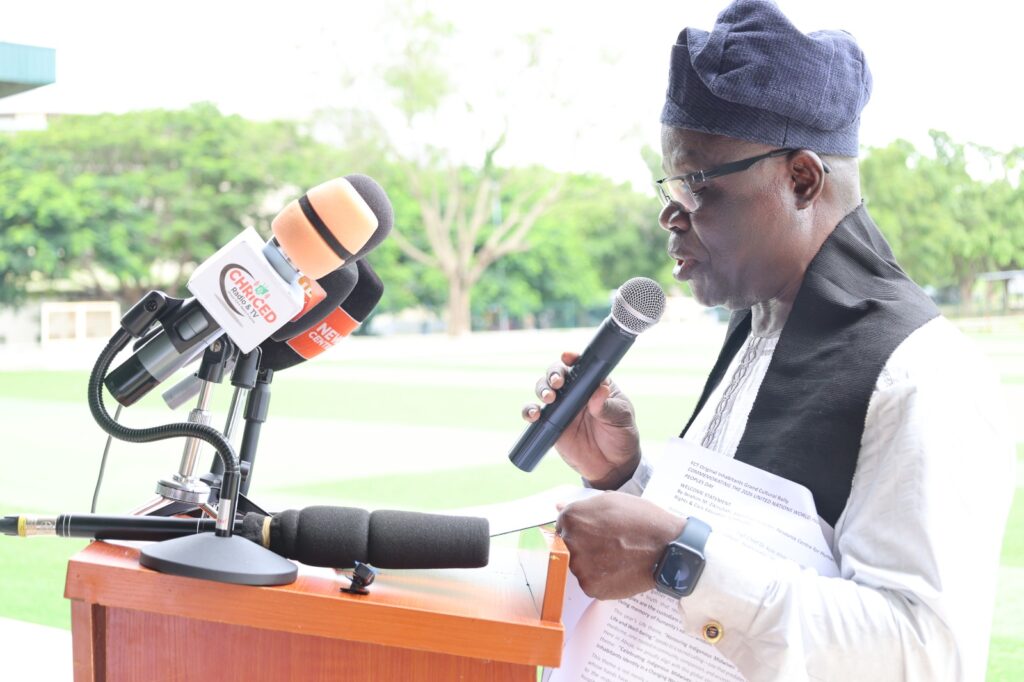
Distinguished traditional rulers, High Chief Dr. Kole Ahmed Shettima, Africa Director, MacArthur Foundation; Honourable Vice Chancellor of the University of Abuja, Professor Hakeem B. Fawehinmi and his respected team, esteemed diplomats, respected government officials, partners in development, leaders of civil society, scholars and students of the University of Abuja, representatives of the nine Indigenous tribes of the Federal Capital Territory, members of the press, ladies and gentlemen—
It is with profound honour and heartfelt gratitude that I welcome you all, on behalf of the CHRICED Board of Directors, to the 2026 United Nations World Indigenous Peoples Day celebration, here at the Convocation Ground of the University of Abuja.
Today, we gather not only to commemorate a global observance but also to affirm a truth that resonates deeply across generations: Indigenous Peoples are the custodians of identity, the guardians of heritage, and the living memory of humanity’s earliest wisdom.
This year’s UN theme, “Honouring Indigenous Midwives: Safeguarding Life and Well-being,” speaks to a sacred calling—one that predates modern medicine, one rooted in community, compassion, and ancestral knowledge. Here in Abuja, we proudly align with this global vision through our local theme: “Celebrating Indigenous Midwives: Preserving Abuja Original Inhabitants Identity in a Changing World.”
This theme is not merely a slogan. It is a tribute. A tribute to the women whose hands have welcomed countless children into the world. A tribute to the midwives whose knowledge has protected mothers long before hospitals existed. A tribute to the cultural wisdom that has sustained the nine Indigenous tribes of the FCT through centuries of change, displacement, and transformation.
Indigenous midwives are more than health practitioners. They are storytellers. They are cultural archivists. They are the first teachers a newborn encounter. They are the bridge between ancestry and the future.
Their work reminds us that identity is not preserved in monuments or documents alone—it is preserved in people, in practices, in traditions, and in the intimate rituals that define community life.
Ladies and gentlemen, as Abuja continues to evolve into a modern capital, the identity of its Original Inhabitants must never be erased, diluted, or forgotten. Their languages, their customs, their land rights, their cultural expressions, and their contributions to national development must be recognized, respected, and protected.
This is why today’s celebration matters. It matters for justice. It matters for inclusion. It matters for cultural continuity. And it matters for the dignity of communities whose stories are too often overshadowed by the rapid pace of urban expansion.
CHRICED, in partnership with the University of Abuja and the FCT Original Inhabitant Organizations—and with the generous support of the MacArthur Foundation—remains committed to amplifying Indigenous voices, strengthening civic participation, and advancing the rights of Abuja’s First Peoples.
And today, with great pride, we highlight a landmark achievement: the proposed establishment of the Abuja Original Inhabitants Heritage Centre, with construction set to begin soon. This Centre will serve as a dedicated space for preserving Indigenous history, protecting cultural memory, promoting research, and ensuring that future generations can learn from and celebrate the rich heritage of Abuja’s First Peoples. It stands as a beacon of identity, resilience, and cultural continuity. To achieve this monumental project, we humbly crave the financial and material support of everyone.
At this moment, allow me to express our deep appreciation to High Chief Dr. Kole Ahmed Shettima, the Africa Director of the MacArthur Foundation, and his dedicated team. Their unwavering support, strategic guidance, and commitment to justice, equity, and community empowerment have made this celebration possible. Dr. Shettima’s leadership continues to inspire efforts that uplift marginalized communities and strengthen democratic participation across Africa. We are profoundly grateful for his partnership and for the steadfast support of the entire MacArthur team.
I also wish to thank Professor Matthew Dada, Director of the Centre for Indigenous Studies and Community Relations at the University of Abuja, and his team for working closely with us to make this event possible.
I extend heartfelt gratitude to the CHRICED Board of Directors. Your vision, governance, and steadfast dedication form the backbone of our work. Your guidance ensures that CHRICED remains a principled, courageous, and people-centred organization. Today’s event stands as a testament to your commitment to equity, dignity, and the rights of Indigenous Peoples.
We believe that development must never come at the cost of identity. We believe that progress must honour heritage. And we believe that Indigenous knowledge, including midwifery, is not a relic of the past but a resource for the future.
Today, as we witness cultural performances, listen to ancestral stories, engage in dialogue, and celebrate the resilience of Indigenous communities, let us remember that we are not just observers—we are participants in a collective responsibility.
A responsibility to protect Indigenous rights. A responsibility to promote cultural education. A responsibility to ensure that the next generation of Abuja’s Original Inhabitants grows up proud of who they are.
To our traditional rulers, thank you for your leadership and wisdom.
To our diplomats and development partners, thank you for your solidarity.
To our Original Inhabitant Organisations and communities, thank you for accommodating the Nigerian Capital and for your resilience, commitment, and peaceful approach—even as you continue to suffer demolition and evacuation from your ancestral lands and homes.
To our civil society colleagues, thank you for your advocacy.
To the University of Abuja, thank you for opening your doors to this important gathering.
To the MacArthur Foundation, thank you for your enduring support.
To the CHRICED Board of Directors, thank you for your guidance and strength.
And to the Indigenous midwives we honour today—thank you for safeguarding life, identity, and heritage.
Ladies and gentlemen, I welcome you once again to this historic celebration. May today inspire us.
May it unite us. And may it strengthen our resolve to build a future where Indigenous Peoples are seen, heard, respected, and celebrated.
Thank you, and welcome to the 2026 UN World Indigenous Peoples Day.