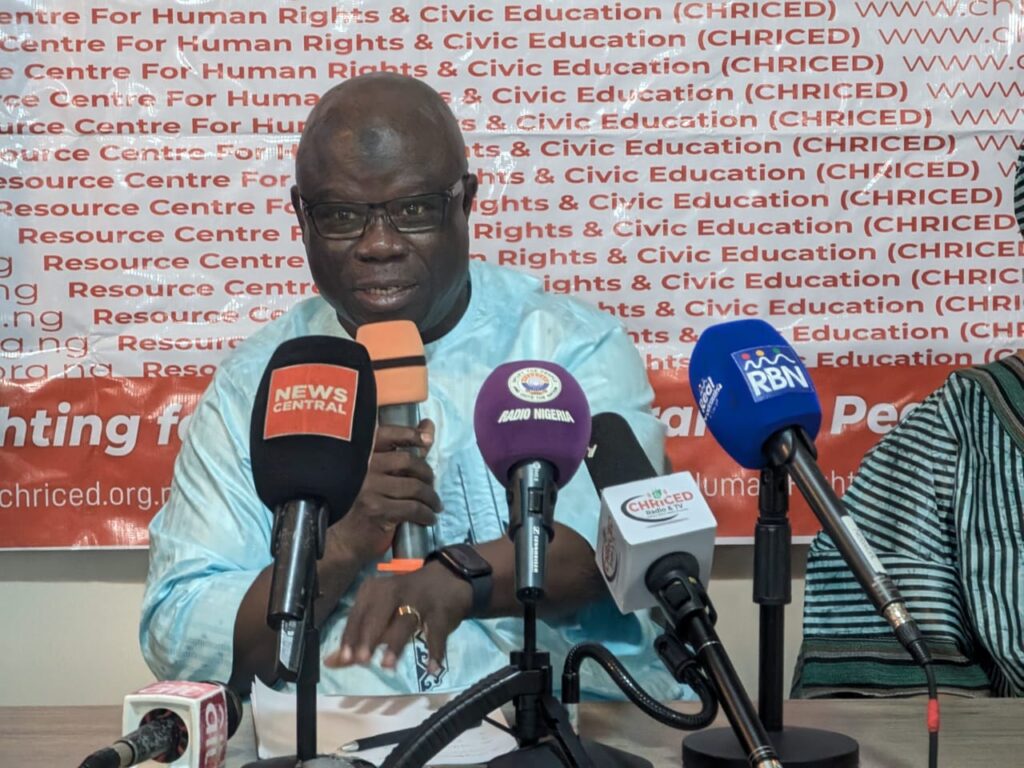
Delivered by Comrade Ibrahim M. Zikirullahi
Executive Director, Resource Centre for Human Rights & Civic Education (CHRICED)
Distinguished members of the press, civil society leaders, development partners, and fellow Nigerians,
Thank you for gathering here at this critical moment in our nation’s history. Today, CHRICED speaks with a deep sense of responsibility and urgency. Nigeria’s governance trajectory is becoming increasingly worrisome. Our democracy is being severely tested — not by foreign adversaries, but by internal failures of accountability, fiscal discipline, and respect for constitutional norms.
For years, Nigerians have endured economic hardship, insecurity, unemployment, and declining public services. Yet instead of relief, recent developments reveal a disturbing pattern: public resources are being mismanaged, misallocated, and in some cases blatantly abused, while voices demanding accountability are being targeted and silenced.
1. Budget Integrity and the Deepening Crisis of Fiscal Recklessness
The 2026 Appropriation Act has once again exposed the erosion of credibility in Nigeria’s budget process.
A Tracka (BudgIT) analysis shows that ₦8.05 billion was allocated for the construction and furnishing of churches and mosques — projects far outside the statutory mandates of the MDAs involved:
• ₦6.14 billion for 52 mosque-related projects
• ₦1.91 billion for seven church projects
Even more troubling is the revelation that the Deputy Speaker’s office allocated ₦780 million for church musical instruments — a figure initially reported as ₦1 billion. But the real question remains: Why should scarce public funds be used to buy musical instruments when millions of Nigerians cannot afford food, have no jobs, and lack access to healthcare and education?
Section 10 of the Constitution is unequivocal: Nigeria shall not adopt any religion as a state religion. Yet public funds are being channelled into religious infrastructure through questionable insertions.
This pattern of fiscal recklessness continues:
• ₦500 million spent on an international communications campaign to counter allegations of religious persecution
• US$9 million awarded to a U.S. lobbying firm to “improve Nigeria’s image”
• ₦6.44 billion allocated for FIFA World Cup qualifying activities after Nigeria had already failed to qualify
Nigerians deserve answers — not excuses.
2. The Almajiri Commission Scandal: A Betrayal of Vulnerable Children
One of the most heartbreaking revelations is the misuse of funds meant for the National Commission for Almajiri and Out-of-School Children Education.
Of the ₦22.8 billion allocated to the commission, billions were diverted to questionable road projects across Ogun, Katsina, and Ekiti States — projects with no direct link to the education or welfare of almajiri children.
Examples include:
• ₦1.4 billion for roads in Abeokuta
• ₦1.05 billion for roads in Ipokia Ward 2
• ₦1.4 billion for roads in Imeko and Idogo
• ₦1.05 billion for internal roads in Katsina
• ₦700 million for solar streetlights in Katsina
• ₦700 million for “women and youth empowerment tools”
These are not education projects. They are diversions.
It appears the government and politicians have become comfortable watching the children of the poor remain out of school. This is not just mismanagement — it is wickedness and inhumanity. At a time when bandits and insurgents prey on vulnerable children, the government is starving education to fund roads that may never be built.
3. Rising Debt, Poor Releases, and Collapsing Budget Discipline
Nigeria’s public debt now stands at ₦159.28 trillion, according to the Debt Management Office — despite the removal of fuel subsidy, introduction of new taxes, and claims of rising revenue.
If revenues are performing above expectations:
• Why are MDAs complaining of poor releases?
• Why is borrowing increasing?
• Why are annual budgets being extended into multiple years?
The extension of the 2024 and 2025 budgets into 2026 has destroyed the sanctity of annual appropriations, weakened oversight, and blurred accountability.
4. Constitutional Reform and the State Police Debate
CHRICED supports genuine constitutional reform — but what we see today is manipulation, not reform.
The National Assembly has prioritised the executive-backed State Police Bill while sidelining earlier proposals. Constitutional amendment has become a multi-billion-naira enterprise benefiting a select few year after year.
In any civilized democracy, constitutional amendment is a business of the people — not a privileged club of political elites.
State police cannot succeed on a faulty foundation of:
• poorly motivated federal police
• states dependent on federal allocations
• proliferation of arms
• political militias created to rig elections
The walkout by minority lawmakers in the National Assembly underscores the lack of transparency and integrity in the process. Any constitutional amendment must involve extensive public consultation and a national referendum.
5. Institutional Accountability and the Fake Agency Scandal
The ₦1.3 billion Presidential Foreign Intervention Promotion Council scandal exposes deep institutional decay.
Conflicting testimonies from government agencies reveal:
• weak coordination
• poor oversight
• compromised accountability
The continued retention of the President’s Chief of Staff, Hon. Femi Gbajabiamila, despite public outcry, undermines the integrity of ongoing investigations. Without his suspension, no agency — ICPC, EFCC, or otherwise — can conduct an independent, transparent, and fair investigation.
No public official should be shielded from accountability.
6. The Oriire School Abduction: Truth Must Be Told
CHRICED welcomes the conviction of those responsible for the Oriire school abduction. However, a victim’s testimony that the children were released by their captors — not rescued — contradicts official accounts.
This discrepancy must be clarified.
Additionally, allegations that ₦5 billion was released for the children’s freedom in Borno State, with ₦1.9 billion paid and insurgents demanding the balance, must be thoroughly investigated. Profiting from the suffering of children is unforgivable.
7. The Death of Mary Habila
The suspicious death of 26-year-old nurse Mary Habila at the country home of the Minister of Works, David Umahi, demands full transparency.
Even if her family chooses not to pursue the matter for reason best known to them, the public interest requires a thorough, independent investigation. As with the Chief of Staff, CHRICED calls for the immediate suspension of David Umahi until a fair and transparent investigation is conducted.
Justice must not only be done — it must be seen to be done.
8. Escalating Attacks on Opposition Political Parties
Beyond fiscal and institutional failures, CHRICED is alarmed by the growing hostility toward opposition political parties — a dangerous trend that threatens the foundation of Nigeria’s democracy.
Across several states, opposition parties have reported:
• intimidation of members
• disruption of meetings and rallies
• arbitrary arrests
• denial of access to public venues
• weaponisation of security agencies
• targeted violence during political activities
These patterns suggest a deliberate effort to shrink political competition and silence alternative voices.
A democracy without a vibrant opposition is not a democracy — it is an authoritarian project wearing democratic clothing.
Opposition parties are not enemies of the state; they are essential pillars of democratic accountability. When government actors attack opposition voices, they attack the Constitution itself.
CHRICED calls on security agencies and INEC to remain neutral, professional, and guided strictly by the rule of law. Political persecution must stop.
Our Call to Action
CHRICED calls on:
• President Bola Ahmed Tinubu to demonstrate genuine fiscal discipline and address rising debt, questionable allocations, and weak accountability.
• The National Assembly to stop acting as a rubber stamp and restore integrity to the budget process.
• The Budget Office, Auditor-General, ICPC, and EFCC to investigate all allegations of budget irregularities.
• Security agencies to clarify the true circumstances of the Oriire abduction release.
• The National Sports Commission to account for the ₦6.44 billion FIFA allocation.
• Political actors to stop attacks on opposition parties and respect democratic freedoms.
• Civil society, media, faith-based institutions, and professional bodies to intensify demands for transparency and constitutional compliance, especially as Nigeria approaches the 2027 General Elections.
• Development partners to continue supporting democratic governance and citizen participation.
Conclusion
Nigeria stands at a crossroads. Our democracy cannot survive on secrecy, impunity, and disregard for constitutional norms. It can only thrive when:
• transparency replaces opacity
• accountability replaces impunity
• public resources serve the people, not private interests
• political competition is protected, not persecuted
CHRICED urges all public office holders to recommit themselves to openness, fiscal responsibility, and respect for the Constitution.
Together, we can build a Nigeria where governance works, institutions serve the people, and democracy delivers real, tangible benefits.
Thank you.
Long live the Federal Republic of Nigeria.