
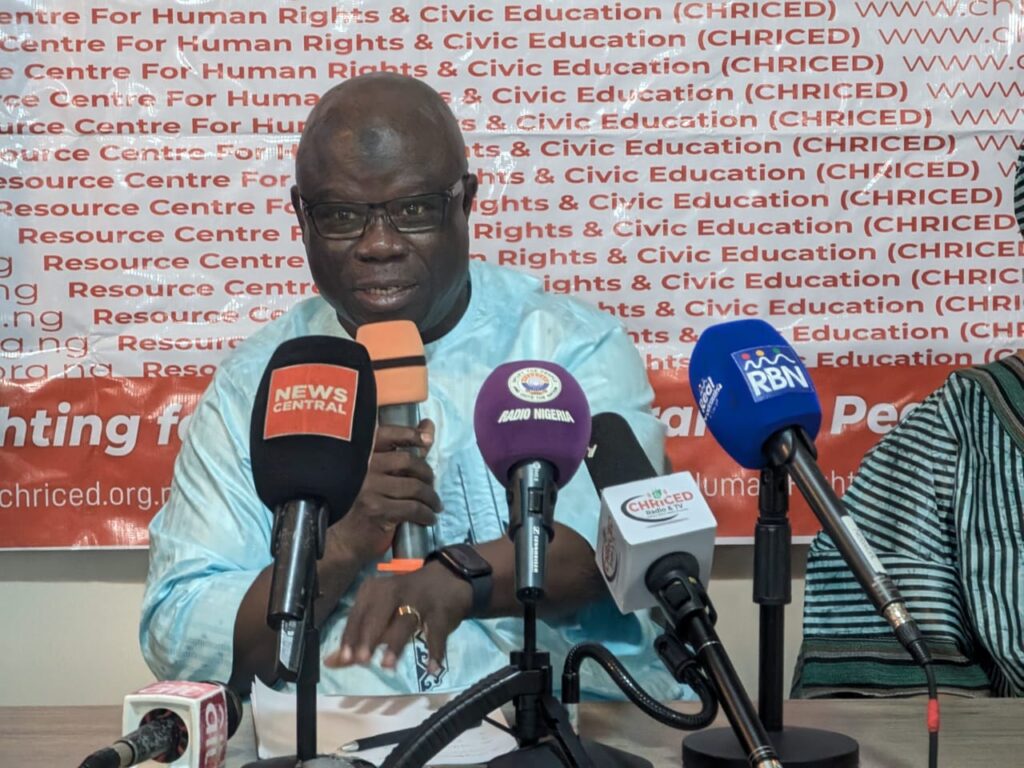
The Resource Centre for Human Rights & Civic Education (CHRICED) expresses deep alarm over emerging indications that Vice-Chancellors, professors and senior university lecturers with clear, recent partisan political involvement may be deployed as Returning and Collation Officers in the 2027 general elections.
Our concern is triggered by a recent Daily Trust report alleging that more than 600 senior academics from public universities in Northern Nigeria attended a closed-door meeting in Kaduna convened by All Progressives Congress (APC) chieftain and Presidential Special Adviser on Political Matters, Ibrahim Masari. According to the report, the meeting was explicitly aimed at “securing the endorsement and active support” of academics for President Bola Ahmed Tinubu’s 2027 re-election bid, and was described as a mobilisation exercise—not an open forum for debate.
CHRICED affirms that academics, like all citizens, have the right to political participation. However, when individuals who have recently taken public partisan positions are subsequently entrusted with the sensitive responsibility of collating or declaring election results, a clear conflict of interest arises. This is not merely a procedural concern—it is a threat to public confidence in Nigeria’s electoral integrity.
Academic Status Is Not a Guarantee of Electoral Neutrality
Nigeria’s electoral history has repeatedly shown that academic credentials do not automatically confer political neutrality.
• Professor Peter Ogban, an INEC Returning Officer, was convicted for manipulating and falsifying election results.
• Professor Ignatius Uduk of the University of Uyo was similarly convicted for offences relating to false election results and perjury.
More recently, concerns were raised about INEC Chairman Professor Joash Ojo Amupitan, SAN, following allegations linking him to a partisan social media account. Although INEC denied the allegation, the controversy underscores a critical truth: every individual entrusted with sensitive electoral duties must be above reasonable suspicion, regardless of status or title.
These cases do not imply that academics are inherently dishonest. They simply demonstrate that professional status cannot replace robust safeguards, transparent selection criteria, and strict conflict of interest rules.
The growing penetration of partisan politics into the academic space—through appointments, advisory roles, patronage networks and political incentives—demands urgent attention. In an environment where inducement and pressure are real risks, INEC must avoid creating opportunities for politically exposed academics to influence electoral outcomes.
Why the 2027 Election Requires Extra Vigilance
The alleged mobilisation of academics becomes even more troubling if individuals involved in partisan endorsement activities are later selected as Returning or Collation Officers.
If a professor publicly endorses a presidential candidate and is subsequently assigned to collate or declare results involving that candidate, the question becomes unavoidable: Can such an officer be reasonably perceived as neutral?
Even if the officer acts with complete honesty, the credibility of the results may still be questioned. This perception alone can fuel allegations of manipulation, rejection of results, litigation, protests and further erosion of trust in INEC.
The danger is not only actual wrongdoing—it is the appearance of compromised neutrality.
Political actors must also be held accountable for any attempt to cultivate or mobilise individuals who may later occupy sensitive electoral positions. University authorities and academic bodies must safeguard the reputation of their institutions by ensuring that partisan activities by individuals are not misrepresented as institutional positions.
OUR DEMANDS
1. Clarification from INEC on the criteria for selecting Returning and Collation Officers for the 2027 elections.
2. Exclusion of politically exposed academics from sensitive result management roles where recent partisan activities create a reasonable appearance of conflict of interest.
3. Uniform standards nationwide—the same criteria must apply to every prospective electoral officer in every region of Nigeria.
4. Transparent conflict of interest guidelines requiring prospective electoral officers to disclose recent political endorsements, campaign roles, political appointments or other significant partisan engagements.
5. Active monitoring by civil society, media and stakeholders of the recruitment and deployment of Returning and Collation Officers, with documentation of credible conflict of interest concerns.
6. Public accountability for political actors who attempt to mobilise individuals likely to occupy sensitive electoral positions.
7. Close monitoring by international election observers—including the United Nations Electoral System, the European Union Election Observation Mission, Commonwealth Observer Group (COG), the African Union and ECOWAS—to ensure the 2027 elections are free, fair and credible.
CHRICED will continue working with election observers and civic stakeholders to promote a nationwide electoral integrity framework that applies equally across universities, regions and political affiliations.
Conclusion
CHRICED is not asking INEC to deny academics their democratic rights. We are insisting that the right to support a political candidate and the responsibility to serve as a neutral electoral officer are two distinct obligations that must never be conflated.
The integrity of an election is protected not only by preventing manipulation, but also by ensuring that those entrusted with the votes are demonstrably independent and visibly impartial.
The 2027 election must not only produce a result—it must produce a result Nigerians can trust.
INEC must act now to eliminate avoidable conflicts of interest and safeguard the credibility of Nigeria’s electoral system.
Signed:
Comrade Ibrahim M. Zikirullahi
Executive Director
Resource Centre for Human Rights and Civic Education (CHRICED)